Last week, Oulu hosted the annual Fall colloquium of the Finnish Society for Environmental Social Science (YHYS). This was my first experience with YHYS, and although I had only just recovered from a rather fierce virus and wasn’t at my best, I was quickly drawn in by the colloquium’s vibrant atmosphere. My main sources of inspiration, however, may sound unusual: nothingness, failure, and the absence of words.
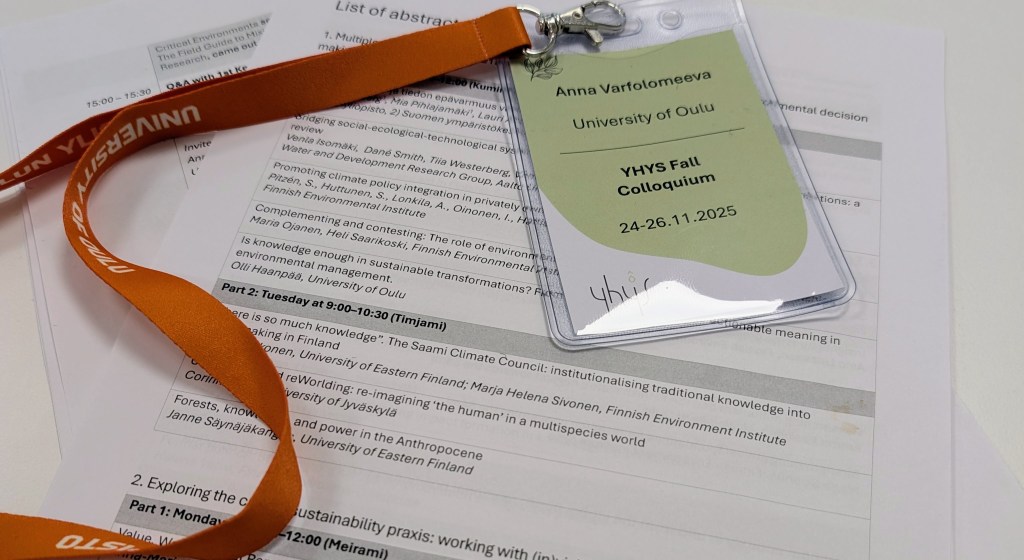
During the session Paradigms of well-being and the challenge of sustainability transformation, I presented my current research interest that I plan to develop further: “nothingness”, erasure, and continuity in Arctic industrial and technological narratives. I spent nearly the whole working day shaping the narrative and trying to fit two case studies into a 15-minute slot. By the end, I was surprisingly happy with my seven slides, and the questions I received were thoughtful and helpful. Ironically, the concept of nothingness, or void, provides so much to research on!

That same evening, I attended a powerful session on academic failure. Together with early-career and senior researchers (perhaps importantly, mostly women) we unpacked the concept: how do we understand failure? why is it not common to speak openly about it, even though most of us do think about it? how can we rethink failure focusing on the system, not our personalities, and be kinder towards ourselves? Two presentations by the University of Oulu researchers Pauliina Rautio and Anna Krzywoszynska, provided deeply personal accounts of thoughts and emotions related to failing, not coping, or not quite succeeding. During the conversation, I fluctuated between inspiration and hopelessness, but I still believe that such open discussions have a therapeutic force.
Finally, on the next day, I attended an art-based workshop where we needed to imagine ourselves as creatures of the future who think with images, not with words. This is normally a difficult task for me, as I am such a word-centered person; perhaps that is why I continuously explore ways of collaborations with artists, as if recognizing a missing element in my work. At the end of the workshop, our collective and individual drawings were exhibited together, inspiring conversations about future, sustainability, and more-than-human relations (our group became especially fascinated with turtles, as the bottom drawing shows).
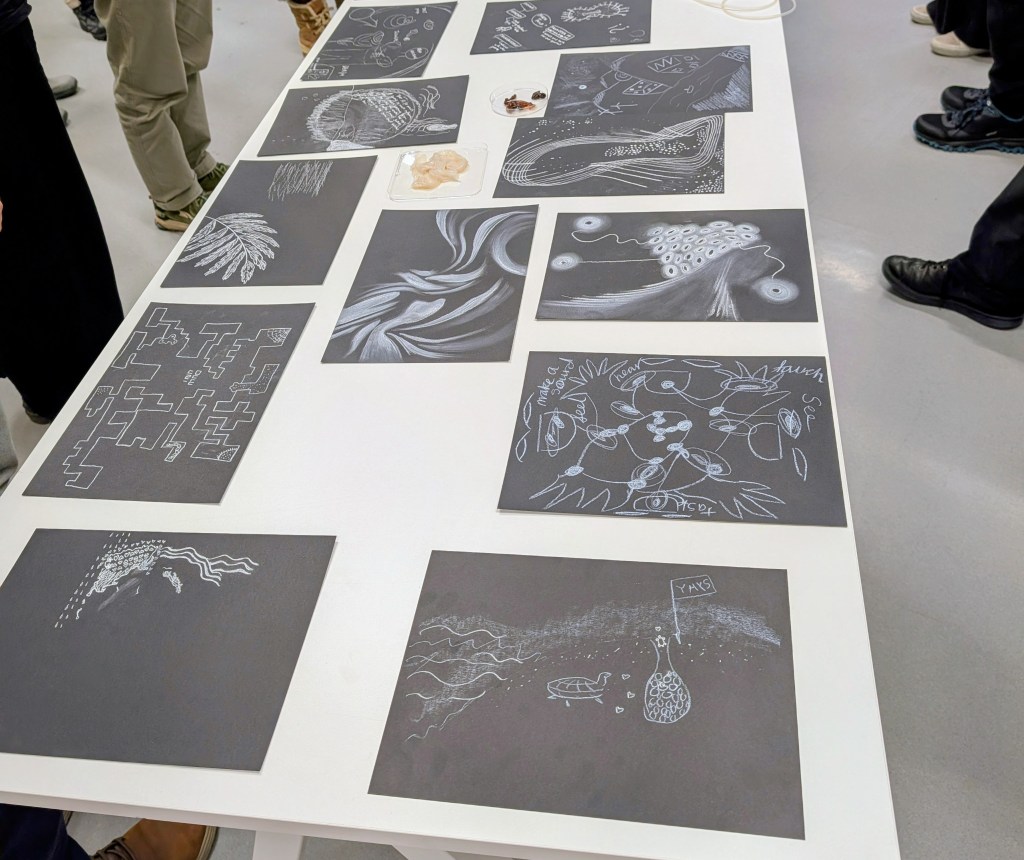
Moving between images and thinking about other-than-words ways of expressing ourselves was a perfect way to end the colloquium. Little did I know that I would come down with yet another virus soon after it ended. Well, this is November. The important thing, as we discussed at the session on failure, is to accept the circumstances and to keep up, to show up, to go on.
 Anna Niia Varfolomeeva
Leave a comment