After returning from the industrial heritage congress TICCIH in Kiruna, I am still thinking and writing about company towns. So much is represented and carried through them: the search for a human-built paradise and the struggle against perceived wilderness, hopes and aspirations often followed by regrets and nostalgia. Perhaps I am fascinated by Arctic industrial settlements because they reveal something fundamental about life itself.
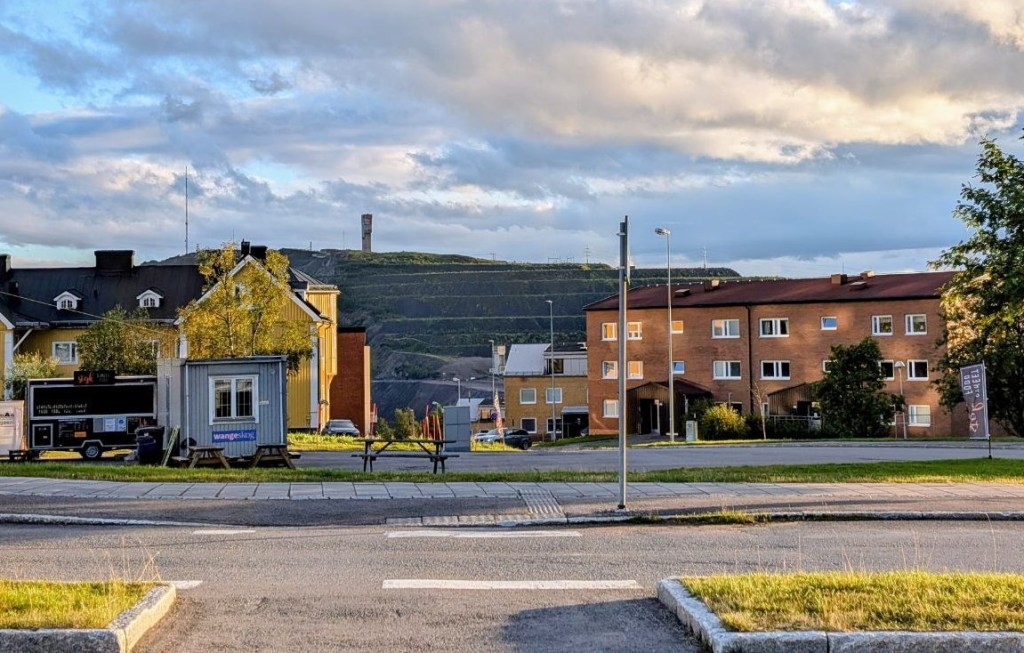
Kiruna, in Swedish Lapland and Sápmi, 140 km north of the Arctic Circle, is a classic company town. It was built in the 1890s to serve the Kiruna mine, and expanded as the mining company Luossavaara-Kiirunavaara Aktiebolag (LKAB) began operations in the early 20th century. Kiruna was envisioned as an “ideal Arctic city”, with several of its buildings designed by the British architect Ralph Erskine.
Today, Kiruna is often branded as “the city on the move”: a phrase that refers to the dismantling of its old center due to the mine’s expansion. The gradual relocation plan was announced by LKAB in 2004. A brand-new center of Kiruna is currently being constructed, and regular public buses connect the old and new parts of the city. On one of these buses, we came across a particularly meaningful note:

Indeed, although many central buildings and shops have been moved from the old center to the new one, the old center nevertheless feels more inhabited. The new center, though very stylish, still resembles a polished presentation leaflet of a community — not yet fully lived in, not yet filled with meaning. Some pages of this leaflet, however, are very appealing: I was glad to spend an hour at the Contemporary Art Museum and to visit the public library with its wide range of activities for all ages.
It is also important to remember that the founding of Kiruna itself was tied to displacement. As Ann-Helén Laestadius, a Swedish-Sámi journalist who grew up in Kiruna, writes: “We shall never forget that the mine, at its beginning, forced two Sámi villages off their grazing land. Now it’s the turn of the Kiruna people to leave their homes” (Shapiro, 2020). This chain of losses and new beginnings continues: as I was leaving Kiruna, news broke that an additional 6,000 residents would have to be relocated.
I first visited Kiruna briefly in 2014, when the move was still mostly a vision. This time, I witnessed it in process—raw and unfinished. I would be very curious to return in several years to see how the meaning-making of the new center unfolds, inevitably mixed with nostalgia for the lost parts of the city.

(Photo source: https://go-kiruna.com/en/visit-to-the-kiruna-iron-mine/)
 Anna Niia Varfolomeeva
Leave a comment